
Olive Oil
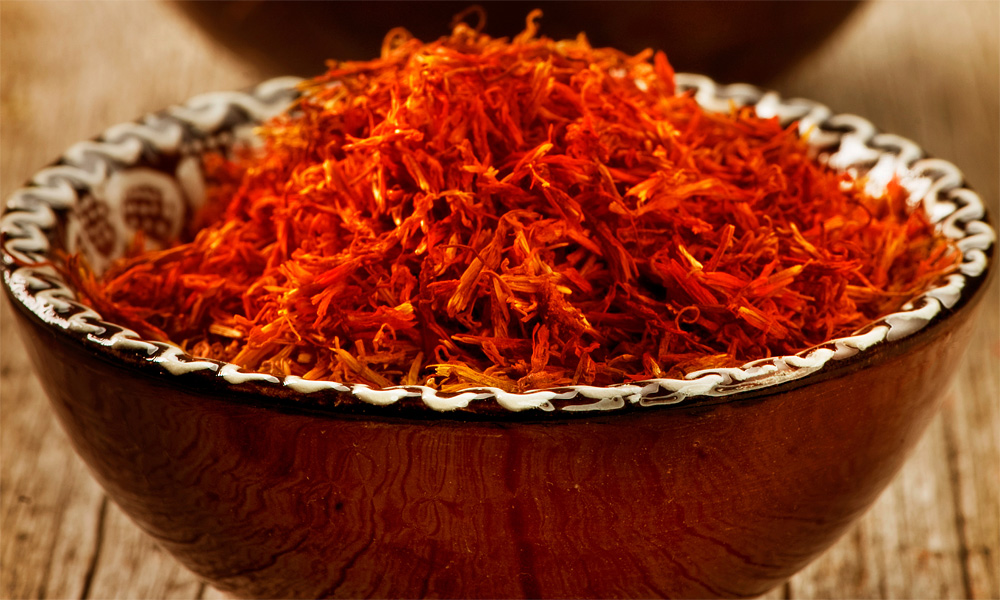
Saffron (pronounced saf-ruh-n)
Background
The first reference to the cultivation of saffron dates back to around 2300 BCE, in a palace of Minoan Crete. Alexander the Great discovered it growing in Kashmir in 326 BCE even though it was not indigenous to the region.
Saffron was valued as a spice and a dye and for its medicinal properties by the ancient Greeks, Persians, Indians and Romans.
Cleopatra used Saffron in her baths and prized it for the coloring and cosmetic properties. She believed that saffron would render lovemaking yet more pleasurable.
The ancient Romans and Greeks prized saffron as a perfume and scattered it about their public spaces. The wealthy Romans used this expensive spice in their baths and used it as mascara, They also used it in their wines and as a potpourri.
The ultimate origin of the English word saffron is, like that of the cultivated saffron clone itself, of somewhat uncertain origin. It immediately stems from the Latin word safranum via the 12th-century Old French term safran. Etymology beyond that point is conflicted.
The Plant
Saffron crocus bears up to four flowers, each with three vivid crimson stigmas, on consecutive mornings; which are the distal end of a carpel. The dried stigmas are used mainly in various cuisines as a seasoning and coloring agent. Cultivated from the crocus flower, saffron is a delicate red thread pulled from the stigma (the female part of the crocus) by hand at harvest each October. Saffron, is among the world’s most costly spices by weight. Because each flower yields only 3 stigmas, it an take the mondadoras (petal strippers) up to 200 hours to yield only 1 pound of saffron – thus explaining why it is the most expensive spice in the world. Saffron’s value has often been compared to that of gold.
Once harvested, the saffron threads are roasted over a gentle charcoal or gas fire to dry and then stored in a dark place free of humidity. Fresh saffron stigmas lose about 80% of their weight in the drying process, which means a region that produces 11 tons of saffron in a year has harvested 55 tons of fresh saffron. True saffron stigmas may be referred to as filaments, threads, strands, silks, fronds, stems, blades, chives or pistils. .
Saffron is a native to Greece and Southwest Asia and was first cultivated in Greece. It has been traded and used for over four millennia. Iran now accounts for approximately 90% of the world production of 185 to 220 tons of saffron. The use of Saffron spans more than 3,500 years.
Almost all saffron grows in a belt bounded by the Mediterranean in the west, and the rugged region encompassing Iran and Kashmir in the east. To extract 1 lb (450 g) of dry saffron requires the harvest of 50,000–75,000 flowers; a kilogram requires 110,000–170,000 flowers. It also requires 40 hours of labor to pick 150,000 flowers.
In February, 2013, a retail bottle containing 0.06 ounces could be purchased for $16.26 or the equivalent of $4,336 per pound or as little as about $2,000/pound in larger quantities. A pound contains between 70,000 and 200,000 threads. Vivid crimson coloring, slight moistness, elasticity, and lack of broken-off thread debris are all traits of fresh saffron. Saffron is the most expensive spice in the world.
Buying & Storage
Saffron is available in two forms – threads and powder. Conventional wisdom says that deep, dark red threads are better than yellow or orange threads. There have been taste tastes done on the different saffron samples of threads with considerable spots of yellow and orange, and did in fact yield the weakest-colored and flattest-tasting broths. The reddest threads yielded intensely flavorful broths.
Conventional wisdom also cautions against the use of powdered saffron. Some sources say that inferior threads are used to produce the powder and that coloring agents may be added. This may be true, but buying powdered saffron from a reputable source, to be just as flavorful and fragrant as even the highest-quality threads.
When shopping for saffron, look for dark red threads without any interspersion of yellow or orange threads. Or, save money, choose a good quality powdered saffron.
Use
Saffron is widely used in cooking many cuisines ranging from risotto of Italy to the bouillabaisse of France to the Biryani in South Asia. When used as a spice, saffron usually needs to be infused in a liquid, the color will start to leach out of the saffron strands within seconds of being immersed; over a period that may range from five minutes to several hours. Saffron has a bitter taste, a hay like fragrance with slight metallic notes. Saffron is used traditionally to color Indian rice dishes, Italian risotto and Spanish paella. It’s unique flavor and color go well with fish, seafood and chicken. Be careful not to add too much saffron to a dish, as an excessive amount will create a bitter, medicinal taste.
Family: Iridaceae
Other Names: azafran, Asian saffron, Greek saffron, Italian saffron, Persian saffron, true saffron
Flavor Group: Pungent
Parts Used: stigmas (as a spice)
Culinary Information:
Combines with * all herbs and spices (used in moderation)
Traditional Uses: Indian rice dishes * Italian risotto and Spanish paella * seafood and chicken dishes * breads * couscous *